
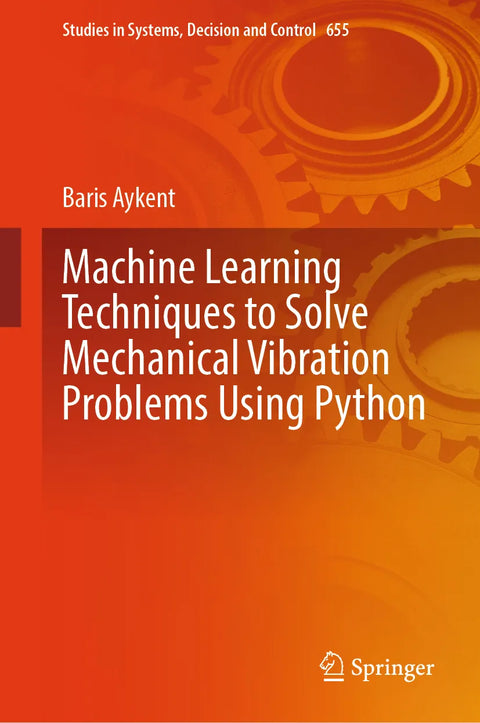
Machine Learning Techniques to Solve Mechanical Vibration Problems Using Python
Machine vibrations hold the secrets to its health, but how do you translate their complex language into actionable, predictive intelligence? As modern industry demands unprecedented levels of reliability and efficiency, the ability to anticipate failures before they occur has become a critical competitive advantage. The key lies in the powerful intersection of classical engineering and modern data science.
Machine Learning for Vibration Problems is the definitive guide for engineers, data scientists, and students looking to master this essential discipline. This comprehensive book bridges the gap between traditional vibration analysis and cutting-edge machine learning, guiding you step-by-step through the entire Prognostics and Health Management (PHM) workflow.
Starting with the fundamentals of signal processing and feature engineering, you will learn to extract meaningful information from raw sensor data. From there, you will journey through a spectrum of algorithms—from interpretable models like Random Forests and SVMs to the powerhouses of deep learning. Master the application of Convolutional Neural Networks (CNNs) for automated feature extraction and Long Short-Term Memory (LSTM) networks for accurately predicting Remaining Useful Life (RUL).
This book moves beyond theory, grounding every concept in practical application with detailed case studies on benchmark industrial datasets and a full annex of illustrative Python code. You will also explore advanced frontiers, including Transfer Learning to overcome data scarcity, Federated Learning for privacy-preserving collaboration, and the adaptive potential of Reinforcement and Continual Learning.
Whether you are a mechanical engineer seeking to leverage data, a data scientist entering the industrial domain, or a student building a foundational skill set, this book provides the critical knowledge and practical tools to transform vibration data into reliable, automated, and predictive maintenance solutions.