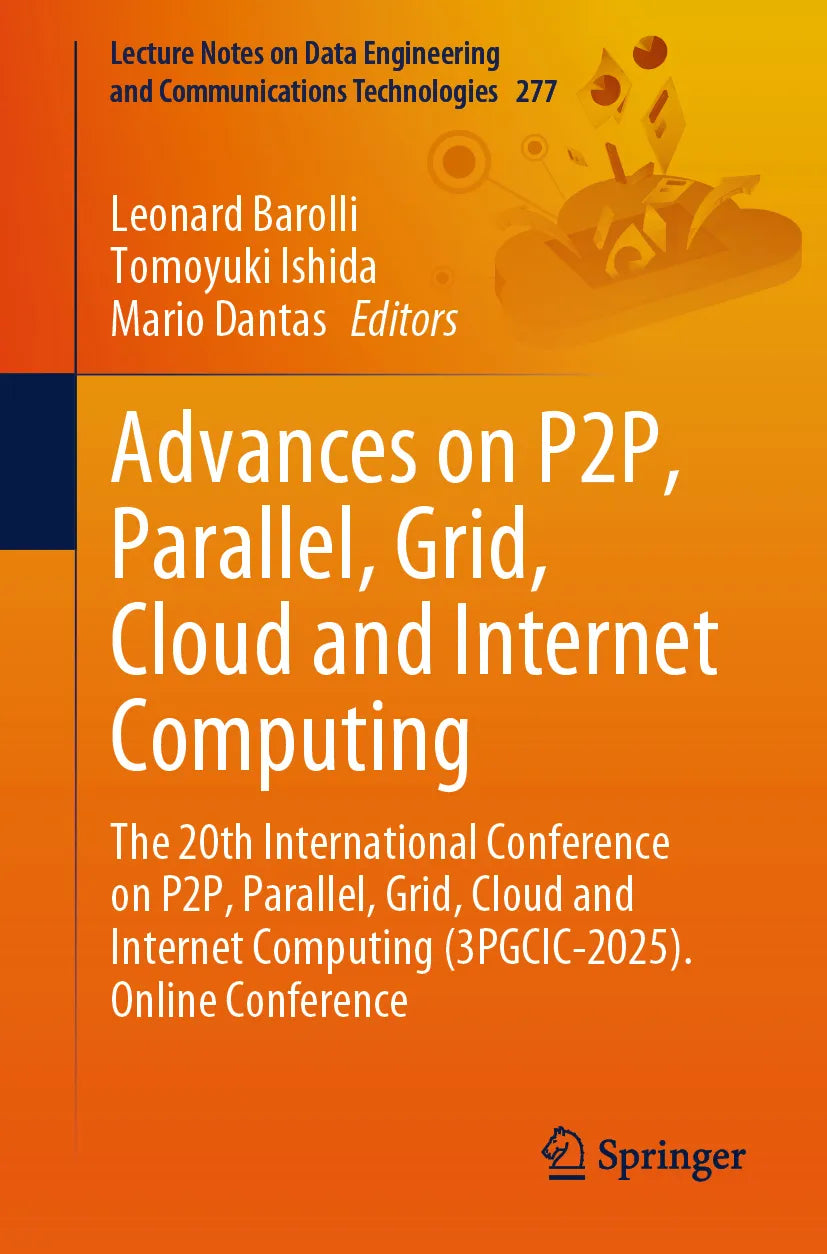
Advances on P2P, Parallel, Grid, Cloud and Internet Computing

The 20th International Conference on P2P, Parallel, Grid, Cloud and Internet Computing (3PGCIC-2025). Online Conference
Angebot€234,33
inkl. MwSt. • Kein physischer Versand
Sofort per Download lieferbar
Ihr Downloadlink kommt direkt per E-Mail.
PDF: lesbar auf Smartphone, Tablet, Computer und in vielen PDF-Apps.

E-Book
eBook-Format:PDF
✓14 Tage Widerrufsrecht
✓Sicher bezahlen – auch auf Rechnung mit Klarna
PayPal Klarna Visa Mastercard Maestro Apple Pay Google Pay
Inhaltsangabe

P2P, Grid, Cloud and Internet computing technologies have been very fast established as breakthrough paradigms for solving complex problems by enabling aggregation and sharing of an increasing variety of distributed computational resources on a large scale. 

Grid Computing originated as a paradigm for high performance computing, as an alternative to expensive supercomputers through different forms of large-scale distributed computing. P2P Computing emerged as a new paradigm after client-server and web-based computing and has shown useful to the development of social networking, B2B (Business to Business), B2C (Business to Consumer), B2G (Business to Government), B2E (Business to Employee), and so on. Parallel Computing is an essential computational paradigm for solving complicated problems quickly. It divides a scientific computing problem into several small computing tasks and concurrently runs these tasks by utilizing parallel hardware and overcoming the memory constraint. Parallel computing is an important part of Cloud environment. However, there are significant differences between cloud computing and parallel computing. Cloud Computing has been defined as a “computing paradigm where the boundaries of computing are determined by economic rationale rather than technical limits”. Cloud computing has fast become the computing paradigm with applicability and adoption in all application domains and providing utility computing at large scale. Finally, Internet Computing is the basis of any large-scale distributed computing paradigms; it has very fast developed into a vast area of flourishing field with enormous impact on today’s information societies serving thus as a universal platform comprising a large variety of computing forms such as Grid, P2P, Cloud and Mobile computing.

The aim of the volume “Advances on P2P, Parallel, Grid, Cloud and Internet Computing” is to provide latest research findings, innovative research results, methods and development techniques from both theoretical and practical perspectives related to P2P, Grid, Cloud and Internet computing as well as to reveal synergies among such large-scale computing paradigms.

Produktdetails
  • Erscheinungsdatum: 12.11.2025
  • Autor/Autorin: Leonard Barolli
  • Reihe: Springer Nature Proceedings excluding Computer Science
  • Format: E-Book
  • Dateiformat: PDF
  • Kopierschutz: Wasserzeichen
  • Dateigröße: 38.4 MB
  • Verlag: SPRINGER
  • Sprache: Englisch
  • Umfang: 328 Seiten
  • ISBN: 9783032103444
  • Lieferung: Sofort per Download
  • Hinweis: Sofort per Download lieferbar. Kein physischer Versand.
  • Kompatibilität: Lesbar auf Geräten und Apps mit PDF-Unterstützung.
Darum lohnt sich dieses Buch

Proceedings of the 20th International Conference on P2P, Parallel, Grid, Cloud and Internet Computing Presents recent research on P2P, Parallel, Grid, Cloud, and Internet Computing Includes innovative findings, methods, and development techniques from both theoretical and practical perspectives

Herstellerinformationen
Springer Nature Customer Service Center GmbH

Email: ProductSafety@springernature.com

Weitere E-Books von Leonard Barolli

Advances in Networked-Based Information Systems

€213,99

This book contains the Proceedings of the 29th International Conference on Network-Based Information Systems (NBiS-2026). The networks and information systems of today are evolving rapidly. There are new trends and applications in information networking such as wireless sensor networks, vehicular networks, opportunistic networks, cloud-edge computing, ubiquitous computing, multimedia systems, multi-agent systems, high-speed networks, IoT, social networking and so on. These kinds of networks need to manage the increasing number of users, provide support for different services, guarantee QoS, and optimize the network resources. For these networks, there are many research issues and challenges that should be considered and find solutions. 

The aim of volume “Advances in Network-Based Information Systems” is to provide latest research findings, innovative research results, methods and development techniques from both theoretical and practical perspectives related to the emerging areas of information networking and their applications.

Zum Buch
1 / 3