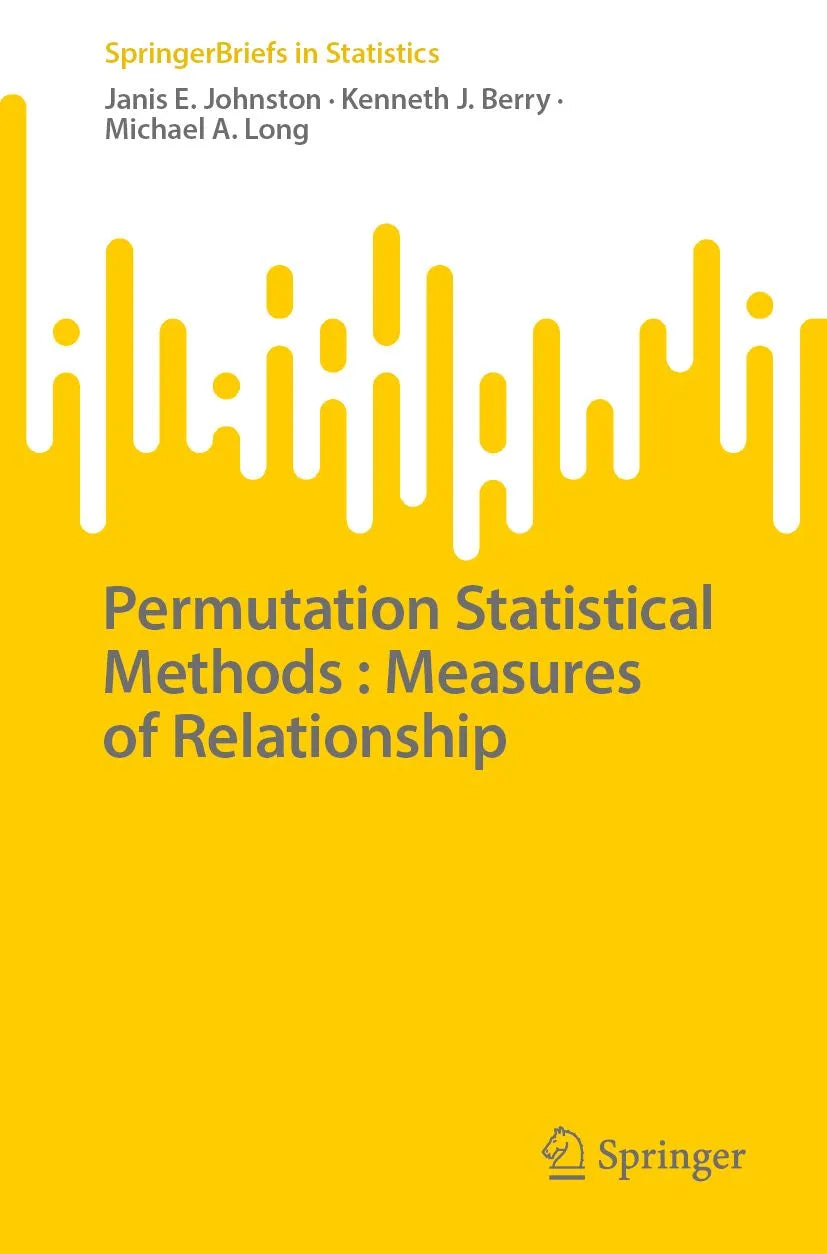
Permutation Statistical Methods: Measures of Relationship

Angebot€53,49
inkl. MwSt. • Kein physischer Versand
Lieferbar ab 01.08.2026
Vorbestellung als E-Book. Download ab Erscheinungstag verfügbar.
Ihr Downloadlink kommt zum Erscheinungstag per E-Mail.
PDF: lesbar auf Smartphone, Tablet, Computer und in vielen PDF-Apps.

E-Book
eBook-Format:PDF
Inhaltsangabe

Chapter 1 Introduction.- Chapter 2 Permutation Statistical Methods.- Chapter 3 Measures of Nominal Association.- Chapter 4 Measures of Ordinal Association.- Chapter 5 Measures of Correlation.- Chapter 6 Mixed Measures of Association.

Produktdetails
  • Erscheinungsdatum: 01.08.2026
  • Autor/Autorin: Janis E. Johnston,Kenneth J. Berry,Michael A. Long
  • Reihe: Mathematics and Statistics (R0)
  • Format: E-Book
  • Dateiformat: PDF
  • Kopierschutz: Wasserzeichen
  • Dateigröße: 4 MB
  • Verlag: SPRINGER
  • Sprache: Englisch
  • Umfang: 124 Seiten
  • ISBN: 9783032266088
  • Lieferung: Download ab 01.08.2026
  • Hinweis: Vorbestellung. Verfügbar per Download ab Erscheinungstag. Kein physischer Versand.
  • Kompatibilität: Lesbar auf Geräten und Apps mit PDF-Unterstützung.
Herstellerinformationen
Springer Nature Customer Service Center GmbH

Email: ProductSafety@springernature.com

Weitere E-Books von Janis E. Johnston

Permutation Statistical Methods

€53,49

The primary purpose of this book is to introduce the reader to elementary statistical methods as related to tests of differences, such as one-sample tests, tests of two independent samples, tests of two matched samples, and one-way analysis of variance. Throughout the book the emphasis is on permutation statistical methods, although the results of the permutation analyses are always compared and contrasted with the results of conventional statistical analyses. Unlike classical statistical methods, permutation statistical methods do not rely on theoretical distributions, avoid the usual assumptions of normality and homogeneity, depend only on the observed data, and do not require random sampling. The book is designed for an audience with limited statistical background and can easily serve as a supplementary textbook in an undergraduate or graduate course in departments such as statistics, psychology, economics, or biology. In particular, the audience for this book is quantitative undergraduate and graduate students in fields such as psychology, sociology, biology and political science. No statistical training beyond a first course in statistics is required.


Zum Buch