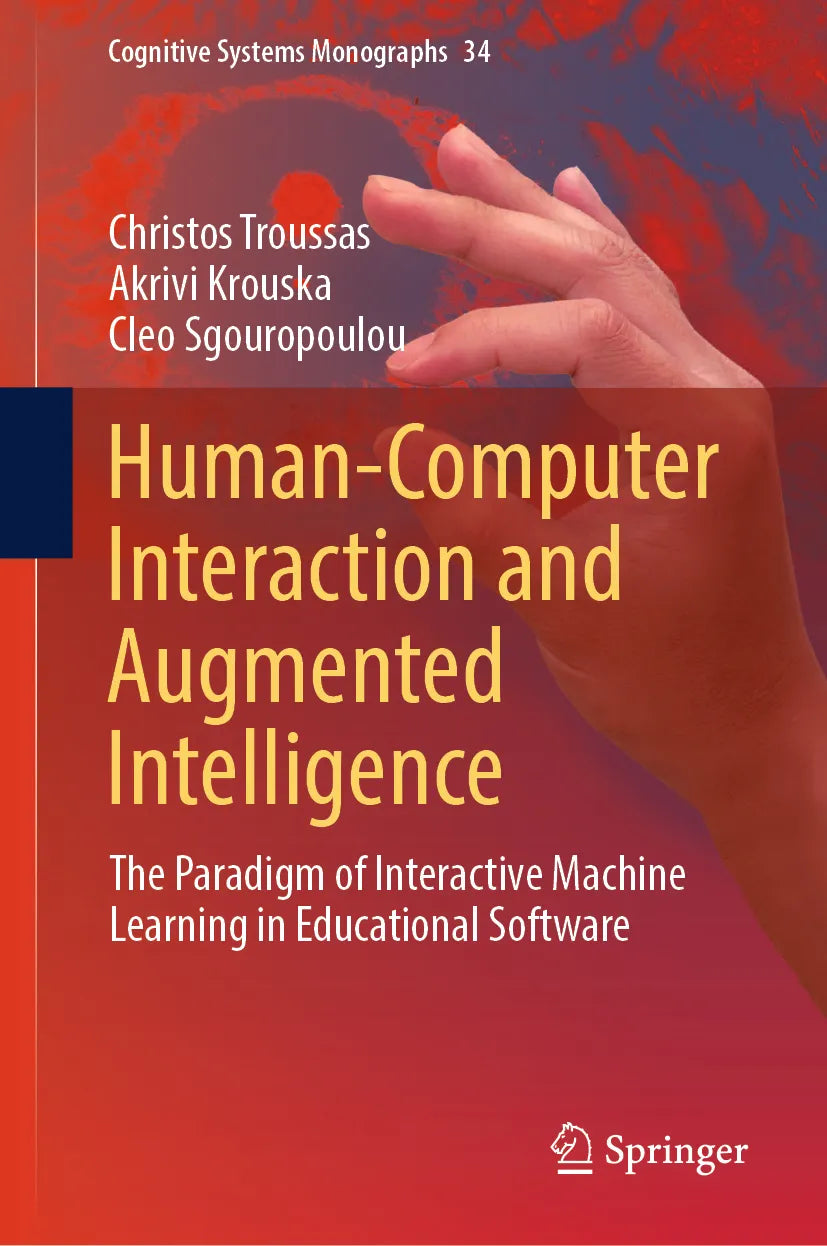
Human-Computer Interaction and Augmented Intelligence

The Paradigm of Interactive Machine Learning in Educational Software
Angebot€160,49
inkl. MwSt. • Kein physischer Versand
Sofort per Download lieferbar
Ihr Downloadlink kommt direkt per E-Mail.
PDF: lesbar auf Smartphone, Tablet, Computer und in vielen PDF-Apps.

E-Book
eBook-Format: PDF
✓14 Tage Widerrufsrecht
✓Sicher bezahlen – auch auf Rechnung mit Klarna
PayPal Klarna Visa Mastercard Maestro Apple Pay Google Pay
Inhaltsangabe

Human-Computer Interaction in EducationHuman-Computer Interaction in Education.- The Role of Augmented Intelligence and Pedagogical Theories in Digital Learning.- Teaching methods and Online Instructional Design.- Cognitive Styles as a Factor of Effective Learning.

Produktdetails
  • Erscheinungsdatum: 13.03.2025
  • Autor/Autorin: Christos Troussas,Akrivi Krouska,Cleo Sgouropoulou
  • Reihe: Intelligent Technologies and Robotics (R0)
  • Format: E-Book
  • Dateiformat: PDF
  • Kopierschutz: Wasserzeichen
  • Dateigröße: 7.2 MB
  • Verlag: SPRINGER
  • Sprache: Englisch
  • Umfang: 431 Seiten
  • ISBN: 9783031844539
  • Lieferung: Sofort per Download
  • Hinweis: Sofort per Download lieferbar. Kein physischer Versand.
  • Kompatibilität: Lesbar auf Geräten und Apps mit PDF-Unterstützung.
Herstellerinformationen
Springer Nature Customer Service Center GmbH

Email: ProductSafety@springernature.com

Weitere E-Books von Christos Troussas

Human-AI Collaboration & Augmented Intelligence: Proceedings of the 1st International Conference (HAICAI 2026)

€192,59

This book presents the peer-reviewed proceedings of the International Conference on Human–AI Collaboration and Augmented Intelligence (HAICAI 2026). It adopts a human-centric approach to contemporary AI, organizing 33 accepted contributions across five pillars: human–AI collaboration and cooperative intelligence; augmented intelligence and hybrid human–machine systems; interaction, experience, and design for intelligent systems; ethical, societal, and responsible AI; and emerging cross-disciplinary frontiers. Its novelty lies in bridging technical advances—LLM agents, neuro-symbolic architectures, multimodal and generative AI—with interaction design, cognitive science, ethics, and applied domains such as education, healthcare, industry, and the arts within a single integrative framework. It addresses researchers, doctoral students, and practitioners across AI, HCI, and cognitive science and serves as a reference for academic study, applied R&D, and teaching.
Zum Buch