

Dr. Emrah Ekrem KARABAG
2 Titel bei CineBuch · E-Book · Ausgaben 2026
 Erschienen am 13.08.2026
Engineering Artificial Intelligence
E-Book
Artificial Intelligence has evolved from a specialized field of computer science into a foundational engineering discipline shaping how modern technical systems are designed, analyzed, operated, and maintained. Today, AI is applied across aerospace, autonomous systems, telecommunications, automotive engineering, manufacturing, cybersecurity, predictive maintenance, robotics, and Digital Twins. Understanding AI requires more than training models or using Machine Learning libraries. Engineers must understand the complete lifecycle: **Mathematics → Data → Algorithm → Training → Validation → Deployment → Monitoring** A high-performing model may still fail in operation because of incorrect data pipelines, environmental changes, inputs outside the validated domain, latency constraints, misunderstood confidence levels, or inadequate safety mechanisms. This book therefore approaches Artificial Intelligence from an engineering perspective. Its central question is: **How can AI be engineered into reliable technical systems?** The chapters progress from mathematical foundations and Machine Learning to neural networks, Deep Learning, Transformers, Large Language Models, Reinforcement Learning, Generative AI, explainability, safety, and AI Systems Engineering. Theory is connected...
€169,99
Sofort per Download lieferbar
Ihr Downloadlink kommt direkt per E-Mail.
EPUB: lesbar auf Tolino, Kobo, PocketBook, Smartphone, Tablet und in vielen Lese-Apps.
Filter
2 Produkte
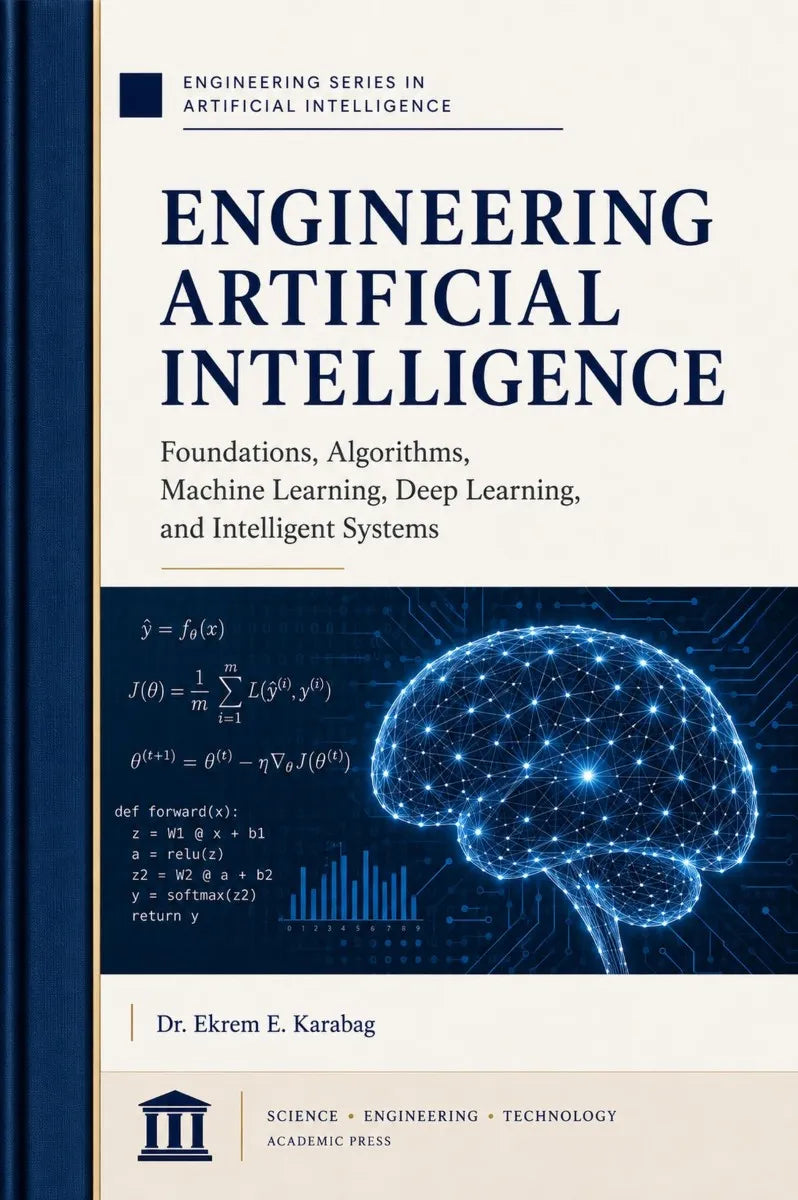
Engineering Artificial Intelligence
Angebot€169,99
AI Assurance for Avionics
Angebot€129,99
Aus denselben Regalen
Ähnliche Autorinnen und Autoren
Wer Dr. Emrah Ekrem KARABAG liest, findet hier Autorinnen und Autoren aus Informatik, EDV.
- Susanne SteffenInformatik, EDV
- Ulrich BreymannInformatik, EDV
- Vladimir GeroimenkoInformatik, EDV
- Wray BuntineInformatik, EDV
- M.A. IvinsInformatik, EDV
- Alvaro RochaInformatik, EDV
 Jörg SchiebInformatik, EDV
- Mattia CerratoInformatik, EDV
