
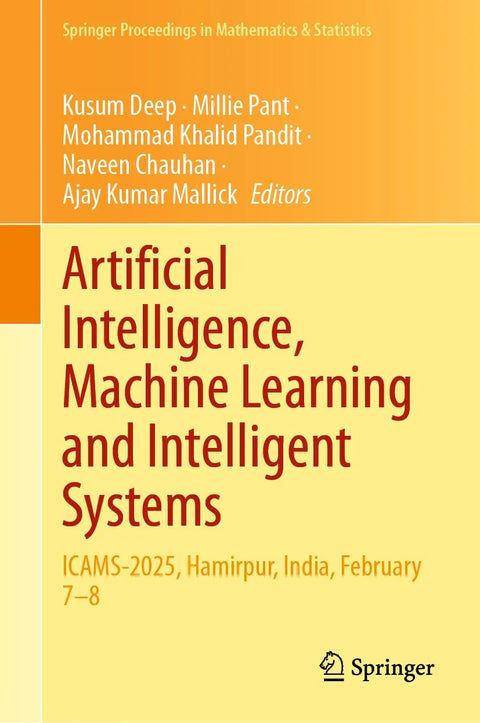
Artificial Intelligence, Machine Learning and Intelligent Systems
Chapter 1. Real-time Unconscious Human Behavior Detection Incorporating Enhanced CSPDarknet53 and YOLOv9.- Chapter 2. Exploring Machine Learning and IoT Technologies for Disease Detection in Cows: A Systematic Review.- Chapter 3. Hybrid Butter Flower Algorithm.- Chapter 4. HEAVY-SARS: Harnessing Explainable AI and Generative Models for Visual Synthetic Data Generation of SARS-CoV-2.- Chapter 5. Infected Hyena Optimizer: A Novel Bio-inspired Metaheuristic Algorithm.- Chapter 6. Socio-nomadic Learning Optimization.- Chapter 7. Binary Tree-based Key Management Scheme for a Ground Station Managing IoT Devices in a Satellite Multicast Communication.- Chapter 8. AI-driven Deterrence System Utilizing YOLO Algorithm for Real-time Wildlife Detection and Mitigation.- Chapter 9. Adaptive Social Robot Navigation Using Vision-Language Models.- Chapter 10. Egocentric Perception for Open Vocabulary Object Rearrangement.- Chapter 11. Sentiment Analysis of Sarcastic Hindi Sentences: Analysis of SVM and XGBoost Models.- Chapter 12. Enhanced Intrusion Detection for Cloud-integrated IoT Networks using Autoencoder-driven Unsupervised Deep Learning.- Chapter 13. Segmentation-based Word Spotting in Handwritten Ayurveda Manuscripts using Siamese Convolutional Network.- Chapter 14. AI-enhanced Pediatric Pneumonia Classification.- Chapter 15. Anomaly Detection in Cryptocurrency Prices.- Chapter 16. GEMNet: Gabor Enhanced Multiscale CNN for Breast Tumor Detection using Biorthogonal Wavelet Transform Features.- Chapter 17. Enhanced Ensemble Learning and Feature Selection for Plant Disease Identification.- Chapter 18. A Novel Review of Obstructive Sleep Apnea Detection using Photoplethysmography.- Chapter 19. Early Detection of Ovarian Cancer from Histopathological Images using Deep Learning Models and Explainable AI.- Chapter 20. Navigating Robot Paths: A Comparative Study of Ant Colony Optimization and Firefly Algorithm for Optimization.- Chapter 21. Adaptive Brake Control for Sustaining Dynamic Stability of Autonomous Vehicles using Markov Decision Process.- Chapter 22. Enhanced IoT Intrusion Detection: Leveraging Dense Autoencoders with Mahalanobis Distance and Gamma-based Thresholding.- Chapter 23. Lidar Point Cloud Quality Assessment in Autonomous Vehicles using Deep Learning Techniques.- Chapter 24. Effective Computer Vision Approach for Surveillance Systems to Detect Stone Crushers.- Chapter 25. Enhancing PCOS Diagnosis with Hybrid ML: Integrating Ultrasound and Clinical Data.- Chapter 26. DNA Splice Junction Prediction using Hybrid Approach of LSTM-GRU Model.- Chapter 27. Machine Learning Techniques-based Predictive Modeling for Wind Speed Forecasting.- Chapter 28. Unsupervised Fabric Defect Detection via Autoencoder Reconstruction and One-class SVM Analysis.- Chapter 29. Predicting Mental Health Issues using Social Media Data: A Machine Learning Approach.- Chapter 30. A Threat Monitoring and Control Unit for Secure Embedded Systems.- Chapter 31. Quantum Steganography-based Least Significant Bit Algorithm for Confidential Data Communication.- Chapter 32. A Survey on Securing the Future of Electric Vehicles and its Charging Stations.- Chapter 33. Automatic Speech Recognition for Telugu Language using Pre-trained Wave2Vec 2.0 Model.- Chapter 34. Secure Biological Data Transfer Using Network Coding.- Chapter 35. MedSum: Medical Video Summarization using Reinforcement Learning.