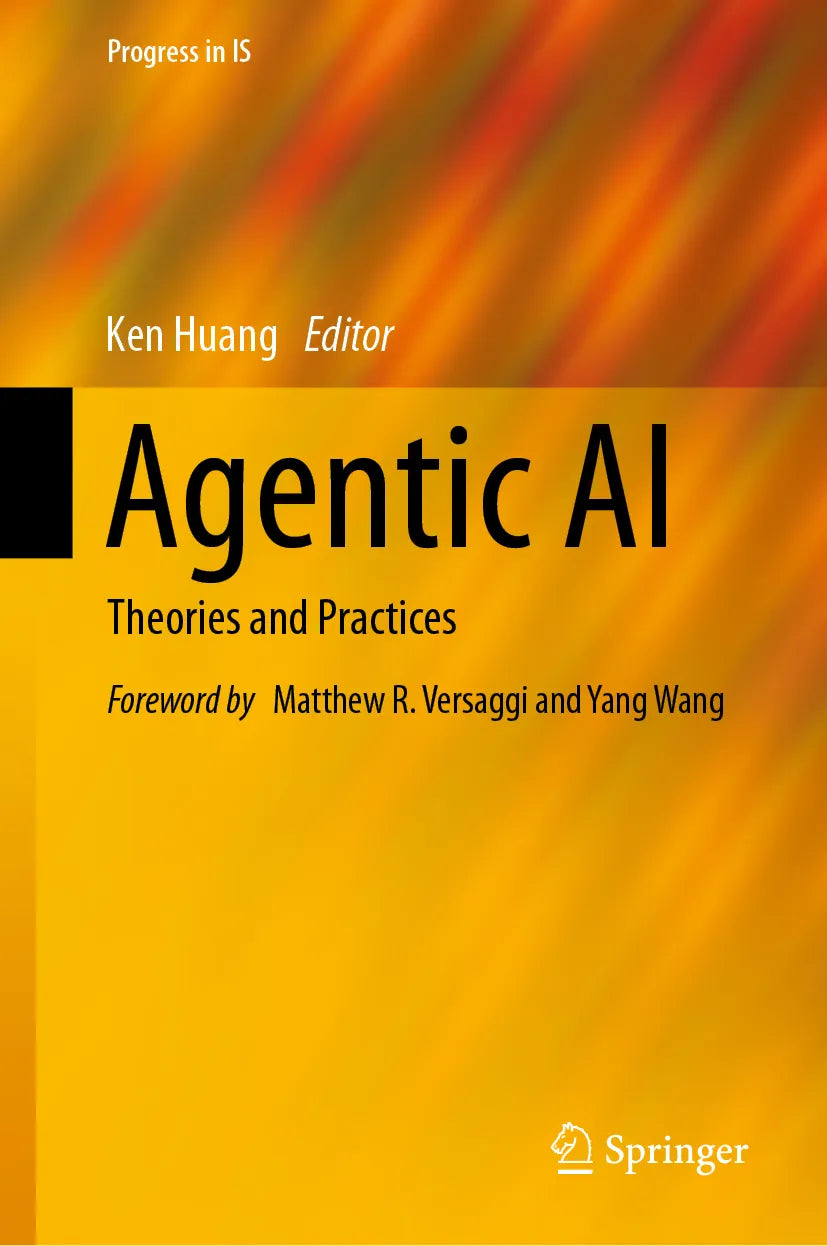
Agentic AI

Theories and Practices
Angebot€128,39
inkl. MwSt. • Kein physischer Versand
Sofort per Download lieferbar
Ihr Downloadlink kommt direkt per E-Mail.
PDF: lesbar auf Smartphone, Tablet, Computer und in vielen PDF-Apps.

E-Book
eBook-Format:PDF
✓14 Tage Widerrufsrecht
✓Sicher bezahlen – auch auf Rechnung mit Klarna
PayPal Klarna Visa Mastercard Maestro Apple Pay Google Pay
Inhaltsangabe

This book analyzes the rise and transformative impact of generative AI agents or Agentic AI across industries, offering a comprehensive exploration of their development, applications, and implications. It highlights how these systems are revolutionizing business processes, enhancing decision-making, and reshaping entire sectors from finance to healthcare. It traces the evolution of AI agents from early programs to today’s sophisticated autonomous systems, providing a taxonomy of agent types. It then explores cutting-edge tools and frameworks for development, such as AutoGen, Langgraph, and CrewAI, offering practical insights for their deployment. Key focus areas include evaluating multiagent systems and coordination techniques, addressing challenges in communication, and conflict resolution. The book presents case studies from banking, insurance, healthcare, and cybersecurity, showcasing how autonomous agents are automating tasks and driving innovation. In turn, the book provides in-depth analyses of Agentic AI in emerging fields like gene editing, robotics, and business process automation, demonstrating its potential to accelerate scientific research and value creation. The discussion extends to economic ramifications, examining impacts on macroeconomic trends, microeconomic dynamics within businesses, and the emergence of decentralized, token-based economies. Throughout, thought-provoking questions encourage readers to consider the broader implications of these technological advances.

The work concludes with a critical examination of related safety and security considerations, emphasizing the need for proactive measures. Maintaining a forward-looking perspective, it prompts readers to consider how these technologies might reshape industries and society, raising important questions about the changing nature of work, ethical aspects, and equitable distribution of benefits. 

Bridging theoretical foundations and practical applications, the book offers valuable insights for data scientists, IT managers, CIOs, CAIOs, CTOs, business analysts, and graduate students seeking to understand and apply AI’s transformative potential across various industries.

Produktdetails
  • Erscheinungsdatum: 09.06.2025
  • Autor/Autorin: Ken Huang
  • Reihe: Business and Management (R0)
  • Format: E-Book
  • Dateiformat: PDF
  • Kopierschutz: Wasserzeichen
  • Dateigröße: 12.4 MB
  • Verlag: SPRINGER
  • Sprache: Englisch
  • Umfang: 407 Seiten
  • ISBN: 9783031900266
  • Lieferung: Sofort per Download
  • Hinweis: Sofort per Download lieferbar. Kein physischer Versand.
  • Kompatibilität: Lesbar auf Geräten und Apps mit PDF-Unterstützung.
Herstellerinformationen
Springer Nature Customer Service Center GmbH

Email: ProductSafety@springernature.com

Weitere E-Books von Ken Huang

Humanoid Robots and Physical AI

€80,24

This book analyzes the convergence of humanoid robotics and agentic AI, providing the first comprehensive, interdisciplinary examination of how physical embodiment and autonomous intelligence are transforming robotics from research prototypes into practical systems reshaping industries worldwide. It addresses the critical gap in understanding how hardware innovations, AI breakthroughs, economic forces, and societal considerations intersect in the development and deployment of humanoid robots. The scope spans ten engaging chapters covering: hardware and embodiment technologies (actuators, power systems, locomotion); perception and interaction systems (computer vision, sensor fusion, multimodal processing); agentic AI architectures (foundation models, reinforcement learning, planning systems); integration and control (real-time systems, simulation, sim-to-real transfer); safety, security, and reliability (physical safety standards, cybersecurity, adversarial robustness); economic transformation and labor markets (cost analysis, productivity gains, business models); governance, ethics, and philosophy (regulatory frameworks, liability, consciousness debates); psychology and human-robot coexistence (trust, emotional bonding, societal adaptation); and decentralized systems and future convergence (blockchain integration, robot economies, 2030-2050 scenarios). Among the compelling themes addressed are the USA-China technology race in humanoid development, with detailed case studies of Boston Dynamics, Tesla Optimus, Figure AI, Agility Robotics, Apptronik, Unitree, UBTECH, Xiaomi, Fourier Intelligence, and EX Robots. The book examines how different design philosophies, cost structures, and regulatory environments shape humanoid development trajectories.

The book raises critical questions about the future of work, human dignity in automation, robot rights and consciousness, geopolitical competition in robotics, and the convergence of physical and digital intelligence. It provides frameworks for understanding these questions through technical depth, ethical analysis, and practical deployment considerations. As such, the book is intended for robotics and AI researchers, engineers, and graduate students in related fields who seek advanced insights into humanoid development and applications.
Zum Buch