Teil der Reihe: Engineering (R0)

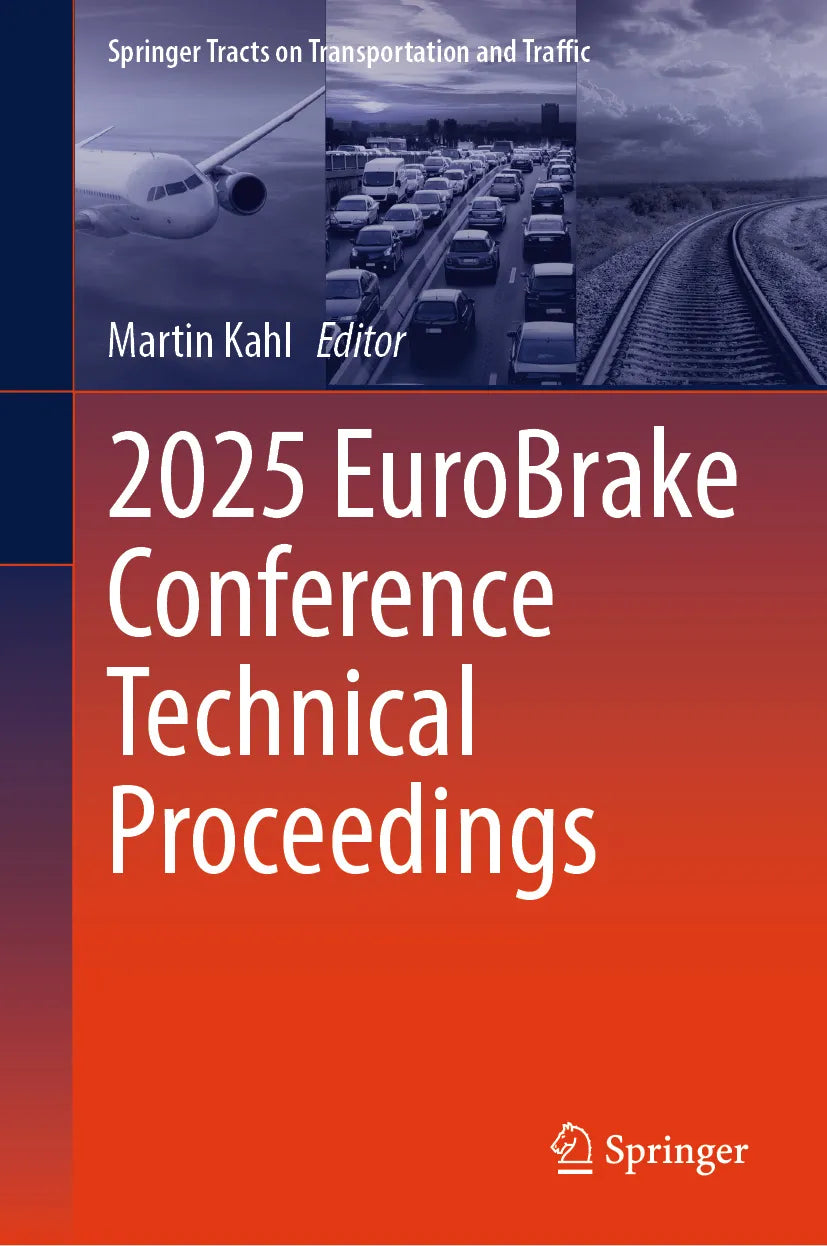
2025 EuroBrake Conference Technical Proceedings

Angebot€234,33
inkl. MwSt. • Kein physischer Versand
Sofort per Download lieferbar
Nach dem Kauf direkt als Download verfügbar.

E-Book
eBook-Format:PDF

Benachrichtigung aktivieren

Wir informieren Sie per E-Mail, sobald dieses Produkt wieder verfügbar ist.

Inhaltsangabe

Chapter 1 - Development of 2-Piston MoC Brake System for Heavy Duty Pick-up Truck.- Chapter 2 - Development of Drum EPB Brake System for Passenger Vehicle.- Chapter 3 - Simulative potential analysis of brake-by-wire systems for integrated chassis control strategies and software-defined vehicles.- Chapter 4 - Design and preliminary experimental tests of an innovative test bench for zero emission braking system.- Chapter 5 - Brake System Durability Testing Using Virtual Test Markets: A new approach to simulate mission related usage variabilities.- Chapter 6 - Evaluating the velocity field in the wake of a brake caliper with optical measurement technique (PIV, Particle Image Velocimetry).- Chapter 7 - Regenerative Braking strategies in EVs: the balance between efficiency, stability, and right-sizing.- Chapter 8 - Braking performance comparison of hybrid SE-MR drum brake and CE-MR drum brake.- Chapter 9 - Navigating the Braking Paradigm Shift: Challenges and Opportunities in Commercial Vehicle Conversions from ICE to Fuel Cell EV.- Chapter 10 - Assessing brake wear particle emissions and performance of FNC-Smart ONC GCI Rotors for Euro 7 Compliance.- Chapter 11 - Niobium Alloyed Ferritic Nitrocarburized Brake Disc.- Chapter 12 - A quantitative approach to understand the relationship between disc homogeneity and brake judder.- Chapter 13 - A Good Control of the Microstructure as a Potential Tool to Improve Wear Behavior of Hypereutectic Grey Cast Iron.- Chapter 14 - A New Potassium Hexatitanate.- Chapter 15 - Methodology for generation, collection and analysis of primary data for tyre airborne emission factors.- Chapter 16 - How effective is the collection of particles for reducing the non-exhaust emission footprint of road transport? An LCA and CBA analysis for EU light-duty vehicles and fleets.- Chapter 17 - Identifying Critical Operational Conditions Using Statistical Distributions and Complex Eigenvalue Analysis in S-Cam Drum Brakes..- Chapter 18 - CFD Simulation of BPE on a Drum Brake.- Chapter 19 - Development of a Method for optimizing Route Planning with regard to Non-Exhaust Emissions.- Chapter 20 - Thermal Modelling of a Drum Brake: A Multi-Point-Mass Approach.- Chapter 21 - Development of Driver Model for real-time simulation of brake control systems.- Chapter 22 - Parameterization of a Detailed Vehicle Model based on Basic Parameters.- Chapter 23 - A complete forming processes simulation methodology for mechatronic braking component..- Chapter 24 - Brake Cooling Optimization using AI: A Case Study on Audi SUVs.- Chapter 25 - Experimental and Analytical Investigation on Automotive Disc Brake Hot Judder Studied as a Self-Excited Vibration with Time Delay.- Chapter 26 - Investigation of Brake Pad Deformation Under Pressure.- Chapter 27 - Analysis of possible brake emission test for HDVs.- Chapter 28 - Enhancing Vehicle Roadworthiness Inspections: Integrating Brake Pressure Manipulation and Deep Learning for Advanced Brake Performance Analysis of Hydraulic Braked Vehicles.- Chapter 29 - Measurement and characterization of brake particle emissions of a passenger car in extended range of driving conditions.- Chapter 30 - Comparison of TRWP emission behaviour in real driving scenarios of light duty vehicles and heavy duty vehicles.- Chapter 31 - Considerations on Damping Shim Adhesive Bleeding under EPB Loading.

Produktdetails
  • Erscheinungsdatum: 05.05.2026
  • Autor/Autorin: Martin Kahl
  • Reihe: Engineering (R0)
  • Format: E-Book
  • Dateiformat: PDF
  • Kopierschutz: Wasserzeichen
  • Dateigröße: 45 MB
  • Verlag: SPRINGER
  • Sprache: Englisch
  • Umfang: 474 Seiten
  • ISBN: 9783032106889
  • Lieferung: Sofort per Download
  • Hinweis: Sofort per Download lieferbar. Kein physischer Versand.
  • Kompatibilität: Lesbar auf Geräten und Apps mit PDF-Unterstützung.
Herstellerinformationen
Springer Nature Customer Service Center GmbH

Email: ProductSafety@springernature.com